








Finished Goods Warehousing: The Complete 9-Step Process
By Daryl Grove · October 29, 2026 · 15 min read
What is finished goods warehousing?
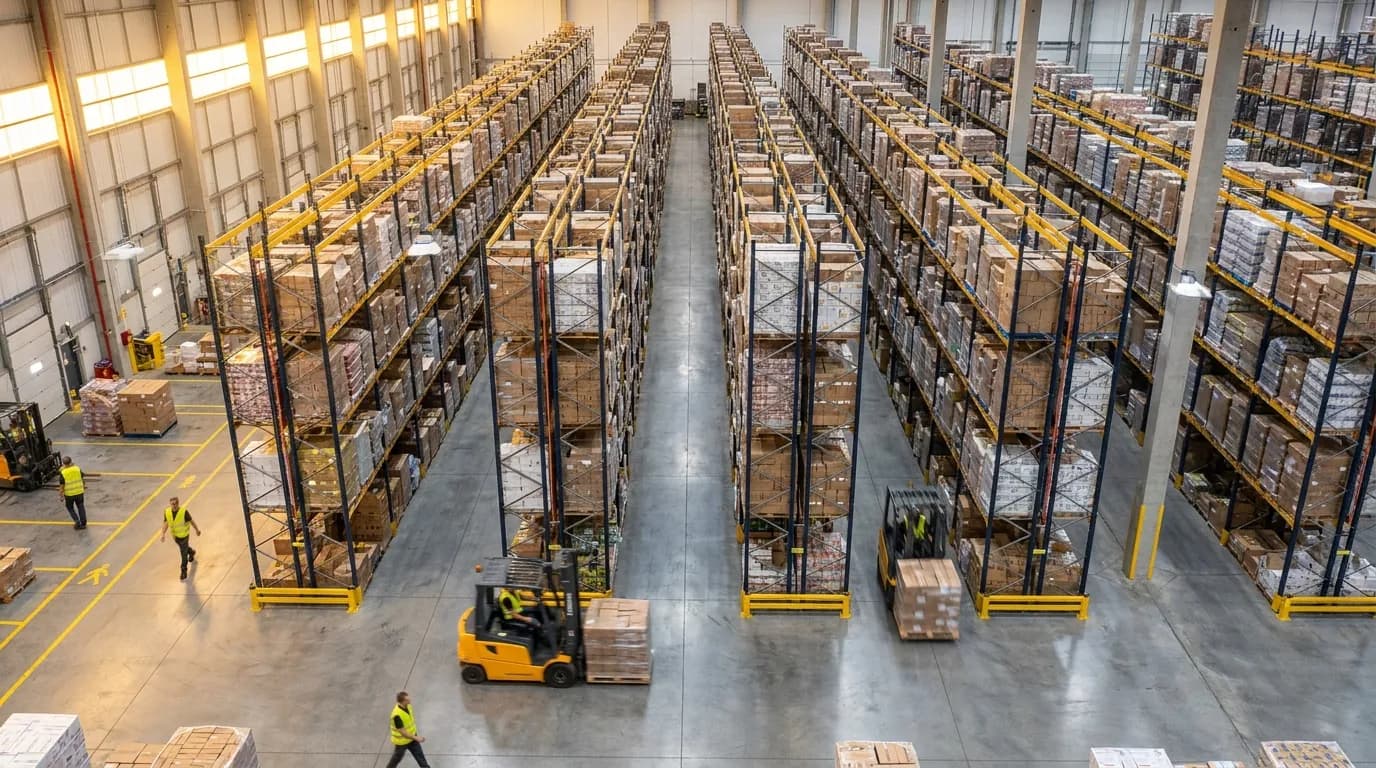
Finished goods warehousing is the storage, control and outbound handling of products that are complete and ready for sale. It begins when a finished pallet arrives from a plant or supplier and ends when that pallet, case or unit ships to a retailer, distributor or consumer. If the product comes back as a return, the process picks it up again.
Manufacturers often run this work in a distribution center they own. Brands and distributors frequently outsource it to a third-party logistics provider (3PL), which stores inventory and fulfills orders for many clients inside shared buildings. Either way, the operational target is the same: ship the correct item, in the correct quantity and condition, on schedule, with the paperwork each customer expects.
How finished goods differ from raw materials and WIP
Manufacturing inventory sorts into three broad buckets. Raw materials are inputs waiting to enter production. Work-in-process (WIP) is partially built product moving through the plant. Finished goods are saleable units with customer-facing packaging, assigned SKUs and, in many cases, lot numbers or expiration dates.
Each category calls for different handling. Raw materials are usually consumed internally, so a packaging or labeling mistake rarely reaches anyone outside the company. WIP stays inside production systems and plant floor routines. Completed products face outside rules instead: retailer label specifications, carrier requirements, recall traceability and shoppers who expect fast delivery. They also bring a much larger SKU count and a wider mix of order types, from full truckloads bound for a retail DC to single-item parcels headed to a home address.
Why finished goods carry the highest stakes
Three factors raise the stakes for this inventory.
- Value. A finished unit carries its full accumulated cost (materials, labor, overhead and packaging). Damage, shrink and obsolescence therefore cut deepest into margin at this stage.
- Compliance. Big-box retailers run vendor compliance programs and issue chargebacks, which are deductions taken from invoices, when a shipment arrives late, an advance ship notice (ASN) is missing or a label is wrong.
- Customer experience. One wrong item in a direct-to-consumer (DTC) parcel can trigger a return, a support ticket and possibly a lost buyer.
The everyday pain points grow directly out of those risks. Warehouse counts drift away from what the ERP shows, so planners and sales teams lose confidence in availability. Dock-to-stock time (the gap between a truck arriving and its contents becoming available to sell) stretches out when receiving relies on clipboards and manual keying. Paper pick lists and handwritten bills of lading slow every step and invite errors. The same compliance penalties keep appearing month after month because nobody can trace which process failed.
Picture a hypothetical food brand shipping to a national grocer. If a pallet leaves with the wrong lot on its label, the grocer may reject it and deduct a fee. During a recall, the brand may also struggle to locate affected stock. That single slip touches value, compliance and customer trust at once, which is why the steps that follow focus on control at every handoff.
Warehousing and fulfillment services explained
People often treat warehousing, fulfillment and distribution as the same thing, but each describes a different job. Knowing which job you are actually doing helps you match the operating model, and the systems behind it, to your order profile.
In practice, most providers blend all three. A single 3PL client might need bulk storage for seasonal inventory, case-pick replenishment for retail stores and each-pick shipping for its ecommerce site. Software, more than square footage, tends to decide service quality in that kind of mixed operation.
Storage vs. fulfillment vs. distribution
Storage is about holding inventory safely and accurately over time, usually at the pallet level, with relatively infrequent outbound activity. This is the traditional core of the discipline.
Fulfillment is about processing orders: picking, packing and shipping, often in small quantities and at high velocity. Speed and order accuracy matter most.
Distribution is about moving product efficiently through a network, such as replenishing retail stores, branches or other DCs. Shipments typically go out in full cases or pallets on scheduled routes, with heavy electronic data interchange (EDI) and appointment requirements.
Value-added services that shape margin
Value-added services (VAS) are where many 3PLs earn their best margins. They are also where many quietly lose money through labor nobody tracks. Typical examples:
- Kitting and assembly: combining components into one sellable SKU, such as gift sets or subscription boxes.
- Cross-docking: moving inbound product straight to outbound doors with little or no dwell time.
- Labeling and relabeling: applying retailer compliance labels, price tickets or country-of-origin marks.
- Returns processing: inspecting, grading, then restocking or disposing of returned goods.
To stay profitable, each service needs its own work instructions, time capture and billing rules. Consumer packaged goods brands rely heavily on these activities, and this article on the consumer packaged goods industry covers several of them in more detail.
Comparing warehousing, fulfillment and hybrid models
The three operating models differ on almost every dimension that matters to a buyer:
- Standalone warehousing: the primary unit is the pallet. Wholesale pallet shipments are its core strength, retail replenishment with EDI and compliance rules is only partially covered, and consumer each-picking is not typical. Cycle times run in days, and the main system demand is location and lot control.
- Fulfillment center: works in eaches and parcels. Single-unit consumer orders are where it shines, while B2B pallet orders are limited and retail replenishment is rare. Orders leave same day or next day, so the software must keep up with order velocity and carrier rating.
- Hybrid/omnichannel: handles pallet, case and each units in one building. Both pallet-level wholesale work and DTC picking are supported, and retail replenishment is a core requirement. Cycle time varies by channel, and the system needs every capability listed above plus channel-specific rules.
Hybrid operations are the hardest to run because a single inventory pool has to meet different service levels and channel rules at once. A pallet reserved for a retailer's EDI order cannot be broken down for parcel orders unless the system knows about it and adjusts the allocation.
Common pricing components
3PL rates for these services usually include:
- Receiving: charged per pallet, carton or unit, sometimes with surcharges for floor-loaded containers.
- Storage: charged by pallet position, bin or cubic foot, billed weekly or monthly.
- Pick and pack: a per-order fee plus a per-unit or per-line fee.
- Accessorials: labeling, kitting, special packaging, rush handling, returns and EDI transaction fees.
Accessorial work that never reaches an invoice is a common source of revenue leakage. Capturing billable events inside the WMS, at the moment the work happens, is far more reliable than reconstructing them in spreadsheets at month end.
The finished goods warehouse process, step by step
The nine stages of handling completed product each have a predictable failure point. Below, every failure is paired with the system capability that prevents it and the KPI that tracks it, so you can audit your operation one stage at a time. The sequence holds for a manufacturer running its own DC and for a 3PL serving dozens of clients. More clients, channels and compliance rules simply make manual workarounds harder to sustain.
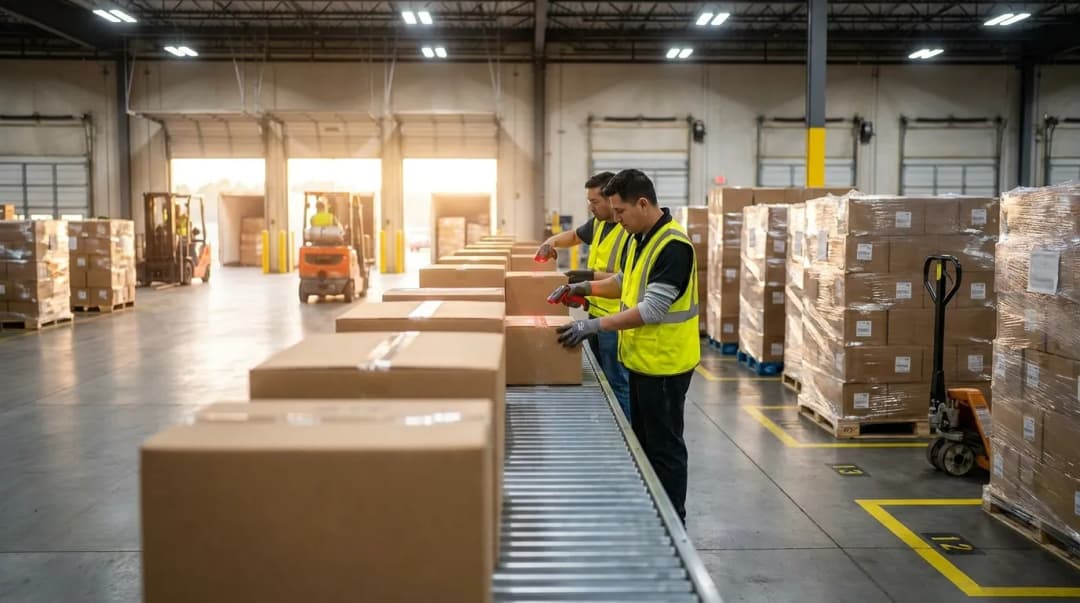
Step 1: Receiving and ASN reconciliation
Receiving begins before the truck arrives. An advance ship notice (ASN), usually an EDI 856 document, lets you plan labor and dock doors.
- Failure point: paper counts keyed in later surface discrepancies days afterward, inviting vendor disputes.
- Fix: scan cartons against the ASN at the dock, flag variances live and assign each pallet a license plate number (LPN).
- KPI: dock-to-stock time and receiving accuracy.
Step 2: Quality control and inspection
Inspection confirms SKU, packaging condition, lot codes and remaining shelf life.
- Failure point: damaged or short-dated stock becomes available and ships to a customer who rejects it.
- Fix: configurable QC holds, sampling prompts, and photos with reason codes for claims.
- KPI: receipts with exceptions and customer rejection rate.
Step 3: Directed putaway and slotting
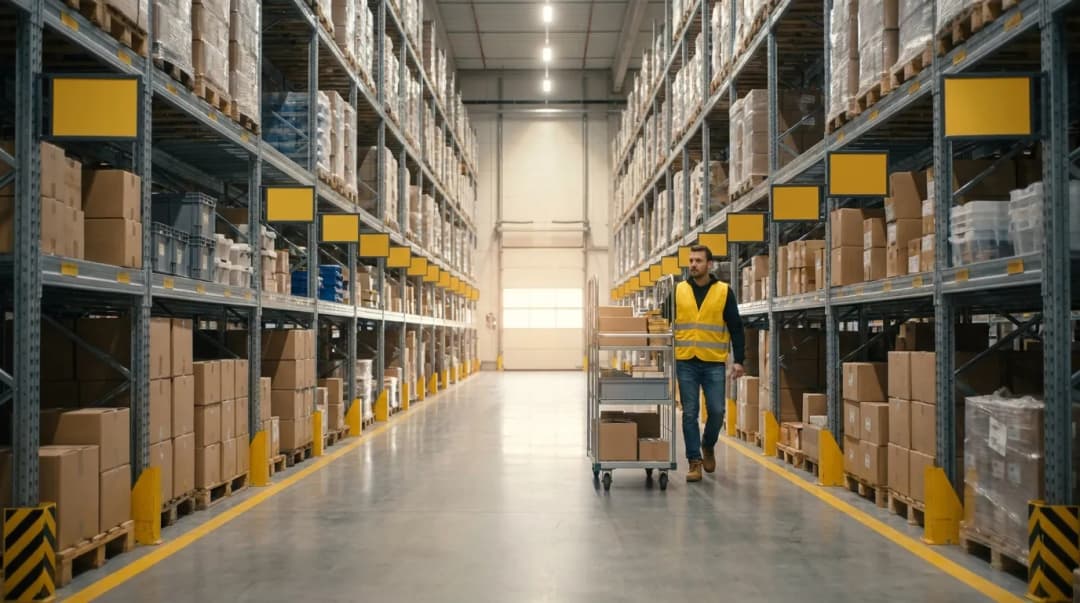
Slotting assigns products to locations by velocity, size, weight and compatibility. Directed putaway tells operators exactly where each LPN goes.
- Failure point: locations chosen from memory cause mis-slots, lost pallets and long pick paths.
- Fix: rules covering capacity, velocity, lot mixing and hazmat segregation, confirmed by a location scan.
- KPI: putaway cycle time and location accuracy.
Step 4: Storage, lot/batch/expiry control and cycle counting
Inventory must stay traceable while it sits.
- Failure point: the system shows 40 cases while the shelf holds 32, or expired product ships because rotation relied on eyesight.
- Fix: lot, batch and expiry tracking with FEFO or FIFO allocation, plus daily counts of a location subset instead of an annual shutdown.
- KPI: inventory record accuracy and shrink or obsolescence write-offs.
Step 5: Picking strategies (discrete, batch, wave, zone)
Picking is usually the most labor-intensive work in the building. Discrete picking handles one order per trip. Batch gathers several small orders at once. Wave releases groups timed to carrier cutoffs, and zone keeps pickers in assigned areas while orders pass between them.
- Failure point: wrong item or quantity.
- Fix: system-directed, scan-verified picking with strategy chosen by order profile.
- KPI: picking accuracy and lines per hour.
Step 6: Packing and compliance labeling
Packing confirms contents, selects cartons and applies labels.
- Failure point: missing or incorrect GS1-128 labels carrying the serial shipping container code (SSCC) trigger retailer chargebacks.
- Fix: scan-to-pack verification, cartonization and automatic retailer-specific labels and packing slips.
- KPI: order accuracy and chargebacks as a share of shipped value.
Step 7: Staging and load verification
Staging groups packed orders by carrier, route or door.
- Failure point: whiteboard-tracked lanes send pallets to the wrong truck or leave shipments incomplete.
- Fix: stage and load scans that keep a trailer open until every LPN on the bill of lading is confirmed.
- KPI: shipping accuracy and mis-ship incidents.
Step 8: Shipping with carrier and EDI integration
Shipping closes out the order and its paperwork.
- Failure point: a late or mismatched outbound EDI 856 earns penalties and delays receipt at the customer's DC.
- Fix: parcel and LTL carrier integration, bill of lading generation and outbound ASNs built from scanned carton data.
- KPI: on-time ship rate and ASN accuracy.
Integration depth varies widely between systems, so our article on choosing the right WMS covers the questions worth asking.
Step 9: Returns and reverse logistics
Ecommerce has pushed return volumes up, and unmanaged returns erode inventory accuracy.
- Failure point: returned goods sit unrecorded for weeks while customers wait for credits.
- Fix: RMA receiving, condition grading, disposition rules (restock, refurbish, liquidate, destroy) and immediate inventory updates.
- KPI: returns processing time and percentage restocked as sellable.
Consider a hypothetical housewares brand selling through a national retailer and its own website. A shopper sends back a blender in an opened box. With grading rules in place, the receiver scans the RMA, marks the unit as open-box, and the software routes it to a refurbish location rather than back into sellable stock. The website's available count stays correct, and the retailer never receives a unit that looks used.
The technology layer: how a WMS powers finished goods warehousing
A warehouse management system (WMS) is software that directs and records every physical movement of inventory inside a facility. For finished product, it is the layer that turns the nine stages from good intentions into enforced, measurable workflows.
Paper and spreadsheets hold up at low volume. They fail once SKU counts climb, retail compliance rules multiply or a 3PL signs clients with different billing structures. Past that point, service quality depends less on how hard people work and more on what the software enforces. For broader context on storage models and facility types, see our complete warehousing guide.
Barcode and RFID scanning
Scanning is the foundation of accuracy. When a receipt, putaway, pick, pack or load is confirmed by a barcode or RFID read, the system writes a timestamped record and stops common mistakes, such as a wrong SKU or a short quantity, before they ship. RFID earns its cost where retailers mandate item-level tagging or where high-value goods need fast counts without line of sight.
Real-time inventory visibility
Transactions captured as they happen keep stock status current. Customer service can promise ship dates accurately, planners can see on-hand quantities by lot and location, and 3PL clients can check their own inventory through a portal instead of emailing for reports. That closes the visibility gaps behind oversells and stockouts.
ERP, ecommerce and EDI integrations
Finished product touches many systems: ERP for orders and financials, ecommerce platforms and marketplaces for DTC, and EDI for retail trading partners. Electronic data interchange (EDI) is the standardized exchange of business documents such as purchase orders (850), advance ship notices (856) and invoices (810). Prebuilt, maintained connectors cut manual order entry and the keying errors it brings.
Retailer compliance and mixed B2B/DTC operations
Serving retail replenishment and DTC each-picks from one building means applying different rules per channel. A retailer order needs routing guide requirements, specific label formats and pack specifications. A consumer order needs carrier rate shopping and a branded packing slip. Inventory stays in one pool while workflows branch by order type, so a holiday DTC surge does not call for a second facility or another piece of software.
Automated billing for 3PLs
For a 3PL, every scan is also a billable event. A WMS that captures receiving, storage, handling and accessorial activity against each client's rate card produces accurate invoices without manual reconciliation. It also stops revenue leakage: the labeling, kitting or rush work that gets done but never invoiced.
How a WMS supports each stage
When you evaluate any warehouse management platform for this kind of inventory, test it against the nine stages rather than a generic feature list. A capable WMS can typically cover:
- Receiving: scan receiving against inbound ASNs, LPN assignment and discrepancy flags.
- QC and putaway: hold statuses, inspection workflows and rules-based directed putaway.
- Storage: lot, batch, serial and expiry tracking, FEFO/FIFO allocation and cycle counting.
- Picking and packing: discrete, batch, wave and zone picking with scan verification and compliance labels.
- Shipping: carrier integrations and outbound EDI 856 transmissions.
- Returns and billing: RMA processing plus activity-based billing capture for multi-client sites.
Pay close attention to how the platform you evaluate handles exceptions, such as a short-shipped carton at the dock or a lot placed on hold after it has already been put away. Exception handling is where weaker systems push staff back onto paper, and it rarely shows up in a polished sales presentation.
The goal is one system of record from dock door to invoice, so ask every vendor you consider to show each of these workflows running end to end rather than on a slide. Request a Demo to see Cadre Technologies in a live environment.
Measuring performance: KPIs and a scalability evaluation framework
Metrics only change behavior when the data behind them is captured automatically and trusted by everyone who reads it. A supervisor who suspects the pick accuracy figure was typed in from a clipboard will simply ignore it. The KPIs below follow the process from the receiving door to the shipping dock. Treat the figures as illustrative targets, not published benchmarks. Results swing widely by industry, order profile and automation level, so your own trend lines matter more than any external number. For formal peer comparison, industry groups such as WERC publish annual benchmarking data.
KPI benchmark table
Each entry below gives the metric, what it measures, a common starting level and a stronger goal to work toward:
- Dock-to-stock: hours from trailer arrival until inventory is available to pick. Many operations begin somewhere around 4 to 8 hours; a stronger goal is under 2 to 4.
- Inventory record accuracy: system quantity compared with the physical count, checked bin by bin. A typical starting level is around 99%, with 99.9% or above as the aim.
- Order picking accuracy: the share of orders picked without error. Roughly 99.5% is common early on; push for at least 99.9%.
- On-time shipping: orders leaving by the promised time. Results in the mid-to-high 90s (%) are common, while 99.5% or better marks a well-run dock.
- Inventory turnover: cost of goods sold divided by average inventory value. Norms depend on sector, so look for the ratio climbing each year.
- Cost per order: total fulfillment cost divided by orders shipped. The right level depends on your order mix, and it should fall as volume grows.
If dock-to-stock is your weakest number, the cause usually sits upstream in how trailers are scheduled, checked and put away. Our breakdown of the warehouse receiving process covers those steps in detail.
Break every KPI out by client and by channel rather than reporting one facility-wide figure. A 99.6% picking rate, for example, can hide a single ecommerce account running at 98% while wholesale orders sit near perfect. Averages smooth over the exact spots where errors begin.
Can your current systems scale? An evaluation framework
Growth exposes system limits faster than anything else. Answer each question below with a plain yes or no, picturing the volume you expect in two years rather than today's workload:
- Visibility: Can clients and customer service staff see inventory by lot and location in real time, without waiting for a report?
- Receiving speed: Is dock-to-stock calculated automatically from scan events, and is it trending down?
- Channel flexibility: Can pallet, case and each-pick orders draw from one inventory pool while following rules specific to each channel?
- Compliance: Are retailer chargebacks tracked by root cause, and does the system generate labels and ASNs instead of staff building them by hand?
- Integration: Can a new ERP, ecommerce or EDI connection go live in weeks rather than months?
- Billing: Is every billable activity recorded at the moment of the scan, or pieced together from notes at month-end?
- Traceability: Could your team identify and isolate every affected unit in a lot-level recall within hours?
Two or more "no" answers usually mean the ceiling on growth is your software, not your workforce. Adding people to a process that depends on spreadsheets and manual label printing raises cost without raising capacity. Those gaps tend to widen with each new client and sales channel, so operations handling finished product benefit from closing them before the next large account signs, while there is still room to change systems without disrupting service.
Frequently Asked Questions
What is finished goods warehousing?
Finished goods warehousing is the storage, control and outbound handling of products that are complete and ready for sale. It starts when a finished pallet arrives from a plant or supplier and ends when that pallet, case or unit ships to a retailer, distributor or consumer. Returns re-enter the process, and the work may be run in-house or outsourced to a third-party logistics provider.
How are finished goods different from raw materials and WIP?
Raw materials are inputs waiting for production, work-in-process is partially built product moving through the plant, and finished goods are saleable units with customer-facing packaging and assigned SKUs. Finished goods face outside rules the other two rarely do, including retailer label specifications, carrier requirements and recall traceability, often with lot numbers or expiration dates attached.
What are the steps in the finished goods warehouse process?
There are nine steps: receiving with ASN reconciliation, quality control, directed putaway and slotting, storage with lot and expiry control, picking, packing and compliance labeling, staging and load verification, shipping, and returns. Each step has a predictable failure point, such as a missing GS1-128 label at packing, that scan-verified workflows in a warehouse management system help prevent.
What is the difference between warehousing, fulfillment and distribution?
Warehousing focuses on holding inventory safely and accurately over time, usually by the pallet with infrequent outbound activity. Fulfillment processes orders by picking, packing and shipping small quantities at high velocity. Distribution moves full cases or pallets through a network, such as replenishing retail stores, on scheduled routes with heavy EDI and appointment requirements.
Which KPIs should a finished goods warehouse track?
Core KPIs include dock-to-stock time, inventory record accuracy, order picking accuracy, on-time shipping, inventory turnover and cost per order. Break each one out by client and channel instead of reporting a single facility average, because a 99.6% picking rate can hide one ecommerce account running at 98% while wholesale orders sit near perfect.
Why do retailers issue chargebacks on shipments?
Chargebacks are deductions retailers take from invoices when a shipment breaks their vendor compliance rules. Common triggers include late arrival, a missing advance ship notice (EDI 856) or an incorrect GS1-128 label carrying the SSCC. Software that generates retailer-specific labels and builds outbound ASNs from scanned carton data reduces these errors.