





Pallet Picking vs. Case Picking: Which Cuts Travel Time?
By Daryl Grove · November 17, 2026 · 18 min read
What Is Pallet Picking and When Do Full-Pallet Picks Make Sense?
In a full-pallet pick, an operator retrieves an entire pallet holding one SKU (stock-keeping unit, the code that identifies a single product variant) and moves it intact to staging or shipping. Nothing gets broken down into cases. One move fills one order line, so this method has the lowest handling time per unit of any approach on the floor.
The trigger is quantity. Full-pallet picks fit when a line's ordered amount meets or exceeds the standard pallet quantity, known as the Ti-Hi (cases per layer multiplied by layers per pallet). Some typical examples:
- A grocery chain reorders 60 cases of a fast-selling sparkling water that ships 60 to a pallet.
- A wholesale distributor sends unbroken loads of paper towels to a regional branch.
- A 3PL fills a big-box DC order written in pallet-quantity lines.
Here is the catch. If your warehouse system allocates only in cases, a request for 70 cases may go out as 70 separate carton picks rather than one pallet plus 10 loose cases. That mismatch between how orders arrive and how the system allocates them decides whether the method saves labor or quietly wastes it.
The Pallet Picking Workflow: Allocate, Travel, Retrieve, Verify, Stage
Each full-pallet move runs through five steps:
- Allocate: Software matches the order line to a pallet-quantity location, typically reserve rack or a floor-stack lane. It then assigns a specific LPN (license plate number, the barcode label tied to one pallet).
- Travel: The driver takes a reach truck, counterbalance truck or pallet jack to that slot.
- Retrieve: The load is lowered or pulled out. In high-bay racking, this tends to be the slowest stage.
- Verify: The driver scans the location and LPN with an RF (radio frequency) handheld or truck-mounted terminal to confirm product, lot and quantity.
- Stage: The driver drops the load at the outbound door or staging lane for loading.
With no carton handling involved, accuracy risk narrows to two points: grabbing the wrong LPN (often a lot or date-code mistake) and dropping at the wrong door. Scan checks at retrieval and staging prevent most of both errors.
The Unit-of-Measure Spectrum: Pallet, Layer, Case and Each
It helps to view picking as a range defined by unit of measure (UOM), the quantity in which an item is handled:
- Full pallet: one SKU at full Ti-Hi, moved intact. Fewest touches per unit.
- Layer: one or more complete tiers lifted from a pallet, frequently with dedicated equipment. Common in beverage and grocery.
- Case: individual cartons pulled to build a mixed pallet or cart. This is case picking, the everyday method behind retail replenishment and B2B distribution.
- Split-case (each): inner packs or single units taken from opened cartons. Most touches per unit.
One order frequently crosses several of these levels. A customer might want two pallets of a top seller, 40 cases spread over 15 mid-velocity SKUs, and a few each-picks. The most labor-efficient approach fills every line at the largest UOM its quantity supports.
Pallet Picking vs. Layer Picking: What's the Difference?
Layer picking falls between whole-pallet moves and case picking. Rather than taking the entire load, an operator (or a vacuum or clamp layer picker) removes complete tiers of a single item and sets them on an outbound pallet. A beverage DC could ship five layers of one flavor and three of another on a single rainbow pallet.
This works best when order quantities regularly land on layer multiples below a full Ti-Hi. It also requires uniform, stable product, such as shrink-wrapped drinks or canned goods. It adds equipment cost and depends on accurate Ti-Hi data. If layer-sized orders are uncommon, most operations treat them as case picks and reserve layer equipment for high-volume, consistent SKUs.
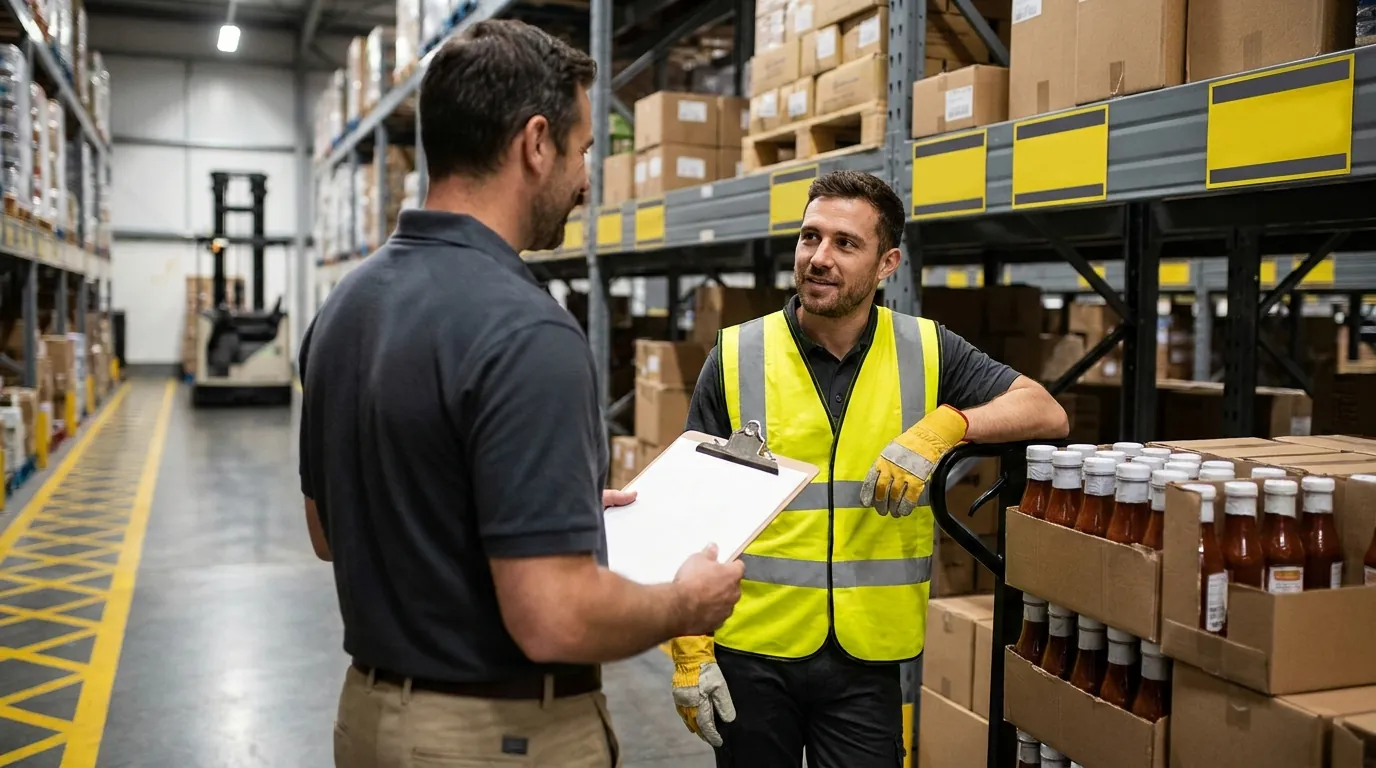
Pallet Picking vs. Case Picking: How Do the Methods Differ and When Should You Combine Them?
Case-level order building means pulling full, unopened cases of one or more SKUs and stacking them onto a pallet or cart. A full-pallet pick moves one SKU in one large unit. A case pick assembles many SKUs in smaller units. That difference shapes travel, labor, equipment and error risk.
Most mid-size distributors run both. Lines at pallet quantity go to reserve, usually by reach truck. Leftover case quantities come from forward slots at ground or low levels, which are replenished from reserve and worked by pickers on pallet jacks or low-level order pickers. Both streams meet at staging, where full and mixed pallets for one order load together. The real decision is where to draw the line between them and how to keep the case stream from burning hours on travel.
Side-by-Side Comparison: Travel, Labor, Storage, Accuracy and Order Profile
Here is how the two approaches stack up, factor by factor:
- Travel per unit: A single pallet trip moves 40 to 80+ cases, so travel per unit stays very low. Carton work requires many stops per order, and driving or walking is often the biggest share of a picker's time.
- Labor per unit: Expect a few minutes for each whole load, compared with seconds per carton plus the movement between slots.
- Equipment: Reach trucks, counterbalance trucks and pallet jacks handle intact loads. Double-pallet jacks, low-level pickers and carts handle carton work.
- Storage: Intact loads live in reserve rack, floor stacks or drive-in lanes. Cartons come from ground or low-level slots and carton flow.
- Accuracy risk: The pallet side risks a wrong LPN, lot or door. The carton side risks a wrong SKU or quantity, plus crushed cases.
- Pallet build: Nothing to build for intact loads, which ship as stored. Mixed pallets need stacking rules for weight, crush and cube.
- Best-fit lines: Quantities at or above a pallet, with few SKUs on the order, favor the full-load approach. Many SKUs with quantities below a pallet favor cartons.
Classify order lines, not whole buildings. Most waves contain both kinds.
One way to apply this comparison: export a week of order lines, divide each line's quantity by the SKU's Ti-Hi, and sort the results. Lines with a ratio of 1.0 or higher belong in the full-load stream, and everything else is carton work. The split you find tells you how much reserve-truck time versus forward-slot labor to plan for each shift.
Case Picking Methods: Discrete, Batch, Zone and Wave
- Discrete: One picker completes one order. It is simple and accurate, but every order walks the full path.
- Batch: One picker fills several orders per trip, such as two orders on a double-pallet jack. Shared aisles and SKUs cut travel per order.
- Zone: Pickers stay in assigned areas, and orders pass between them or consolidate afterward. Travel and congestion drop, but this approach needs a consolidation step and balanced workloads.
- Wave: Orders release in timed groups by carrier cutoff or route, then get picked with any method above. For the tradeoffs of this release model, see our comparison of wave picking vs. waveless picking.
These layers stack. A typical mid-size setup releases waves by route, batches within each wave, and pulls pallet-quantity lines in parallel. The order picking entry on Wikipedia covers the broader taxonomy.
Worked Example: Travel Time for One Order Wave Under Three Methods
Take a hypothetical wave of 40 store-replenishment orders totaling 1,200 cases. Assume pallet-jack speed of about 250 ft/min, handling of about 9 seconds (0.15 min) per case, and an average discrete trip of 900 ft.
Scenario A, discrete: 40 trips × 900 ft = 36,000 ft, roughly 144 minutes traveling. Handling adds 1,200 × 0.15 = 180 min. Total: about 324 min.
Scenario B, batches of two orders per trip: 20 trips × about 1,100 ft = 22,000 ft, or 88 min on the move, plus the same 180 min for handling. Total: near 268 min, with travel down roughly 39% and labor down about 17%.
Scenario C, full pallets plus batching: Twelve lines (480 cases) meet pallet quantity and come out as 12 full pallets at about 3 min apiece, 36 min in all. The remaining 720 cases are batched: about 80 min of driving and 108 min of handling. Total: roughly 224 min, about 31% below discrete.
Results depend on layout and order mix, but the pattern holds: batching shortens the case walk, and pallet-quantity allocation removes case handling entirely.
When Does Batch Case Picking Pay Off?
Batching works when orders are small relative to a pallet and overlap in aisles or SKUs, like many store orders drawing from one fast-moving zone. It helps less when single orders already fill a pallet, when orders carry separate hard cutoffs, or when sorting a batch back into orders costs more than the travel saved.
A practical rule: if the average order is well under one pallet of cube and orders in the wave share pick zones heavily, trial batches of two, using a double-pallet jack or two pallets on a low-level order picker. Compare travel ratio before and after, and track pallet-build errors when two orders ride together.
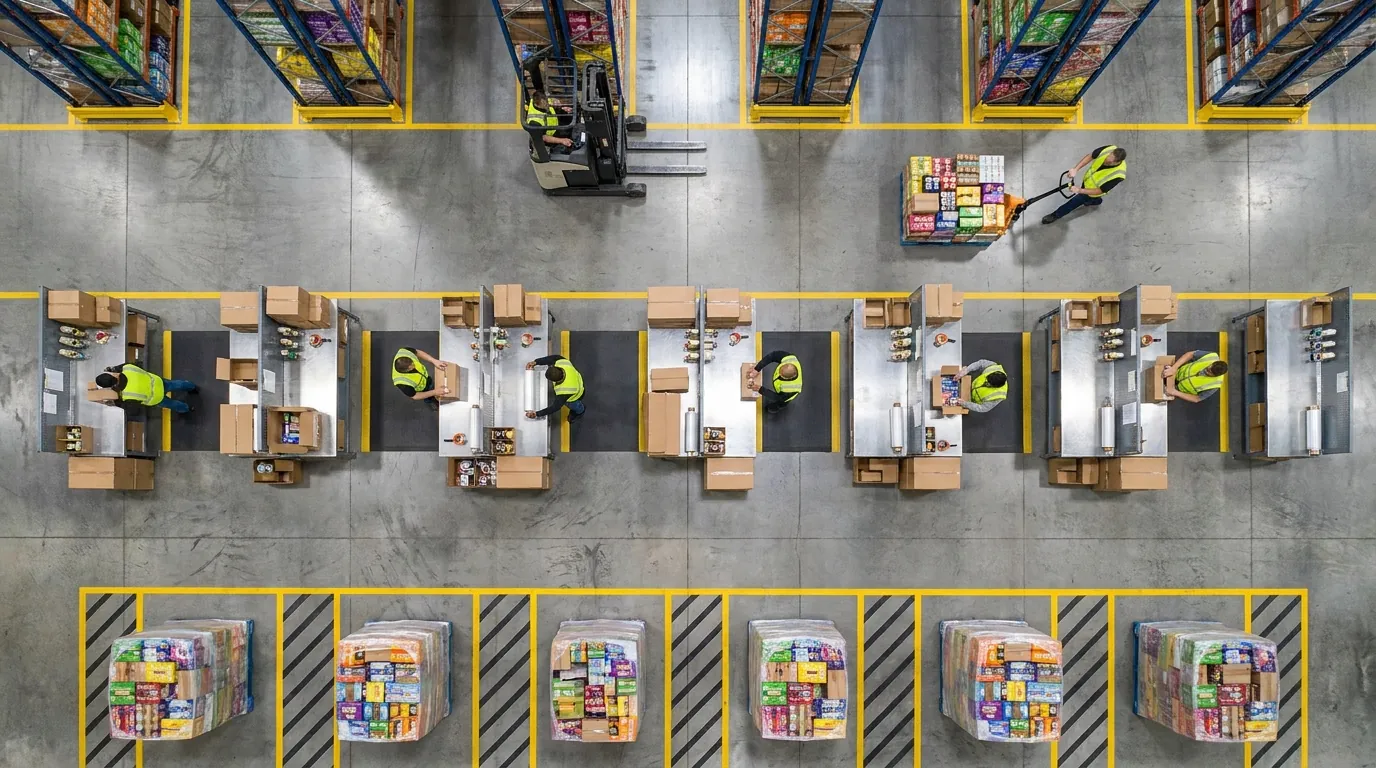
Which Order Picker Machine and Equipment Fit Each Picking Method?
The truck you assign to a task sets travel speed, reachable height, aisle width and the safety rules that apply, so it has to suit the method. Order pickers lift the operator along with the load, which allows case or each picks above the floor. Pallet-handling trucks keep the operator at ground level and move whole pallets. Most mid-size buildings run a mixed fleet, sized around aisle width, rack height, order profile and how many forward locations fit at reachable heights.
Low-Level vs. High-Level (Man-Up) Order Picker Machines
- Low-level: The platform rises a few feet so pickers reach the first and second beams without climbing. It usually carries one or two pallets and moves faster than walking behind a hand jack, which makes it a strong match for high-volume case picking from low forward slots.
- High-level (man-up): The operator rides to upper levels, often 20 to 30 feet or more depending on the model. Picking from the full rack face supports large SKU counts in narrow aisles, but vertical travel lowers hourly throughput, and operators on elevated platforms need fall protection.
Slot fast movers low for the low-level trucks. Save man-up units for slow and medium movers when floor space forces you to go vertical.
Pallet Jacks, Double-Pallet Jacks, Reach Trucks and Counterbalance Trucks
- Electric pallet jack (rider or walkie): The default for ground-level case picks and short moves of full loads from floor stacks.
- Double-pallet jack: Tandem forks carry two pallets for two-order batches, but the truck needs wider turns and more room at aisle ends.
- Reach truck: A pantograph or moving-mast design built for tall racking in narrower aisles. It is the workhorse for full-pallet retrieval and replenishment from reserve.
- Counterbalance forklift: Versatile on docks and in wide aisles, suited to floor-stacked loads and trailer work, though it needs the most aisle space.
For pallet picking from high racks, reach trucks are typical. Near the dock, counterbalance trucks or jacks often cover less distance per pull.
Equipment-to-Method Matrix: Throughput, Aisle Width and Safety
Each truck type lines up with a method, an aisle requirement and its own safety priorities:
- Electric pallet jack: Best suited to ground-level carton picks and short load moves. It works in aisles of roughly 6 to 8 ft, picks at floor height and delivers high throughput there. Safety focus falls on pedestrian traffic and foot protection.
- Double-pallet jack: Built for batched carton work, with the highest output on two-order batches. Plan on 8 to 10 ft aisles plus extra turning room. The long wheelbase limits visibility at aisle ends, so intersections deserve attention.
- Low-level picker: Fits carton picks from the first two rack levels in aisles near 6 to 9 ft. Output is high for fast movers. Platform guarding and safe step-on and step-off habits are the main concerns.
- Man-up picker: Handles case and split-case work from upper levels in narrow 5 to 6 ft aisles, often with wire or rail guidance. Output is moderate because vertical travel adds time, and fall protection is mandatory.
- Reach truck: The specialist for intact loads and replenishment in high racking, operating in roughly 8 to 10 ft aisles. Its rate is moderate when counted in pallets but high when counted in cases moved. Load stability at height is the key risk.
- Counterbalance truck: Covers floor-stack pallets and dock work in 11 to 13 ft aisles, reaching low to mid height. It is flexible and dock-centric, with tip-over risk and pedestrian zones to manage.
Treat these as typical ranges and confirm them against your truck specs and rack design. Every powered industrial truck operator needs training and evaluation under OSHA 29 CFR 1910.178.
Fleet mix also affects charging and maintenance planning. A building that relies on double-pallet jacks for batches needs enough batteries or chargers to keep those units running through peak waves, while a reserve-heavy operation should budget mast and hydraulic upkeep for its reach trucks.
Order Picker Machine or Pallet Jack? A Decision Framework for Your Order Profile
Score your SKUs and order lines on four variables:
- SKU velocity: Fast movers go in ground or low forward slots served by jacks or low-level trucks. Slow movers can sit higher, reached by man-up units.
- Cases per order line: At or above full pallet quantity, send a reach or counterbalance truck. Layer multiples point to layer picking, and anything below a layer is a case pick.
- Cube per order: Orders well under a pallet of cube are batch candidates for double jacks or two-pallet pickers. Orders that fill one or more pallets should be picked discretely.
- Lines per order: Many lines spread across many aisles mean travel dominates, so batch, zone and optimize pick paths. Few lines with large quantities favor full-pallet pulls.
The short version: choose a pallet jack when most picks come from floor slots, a low-level picker when you need the second beam to hold your forward SKU count, and a man-up truck only when SKU count and floor space leave no other choice. Task-assignment rules in a warehouse management system can then route each pick to the right truck type, so the framework shapes daily work instead of sitting on paper.
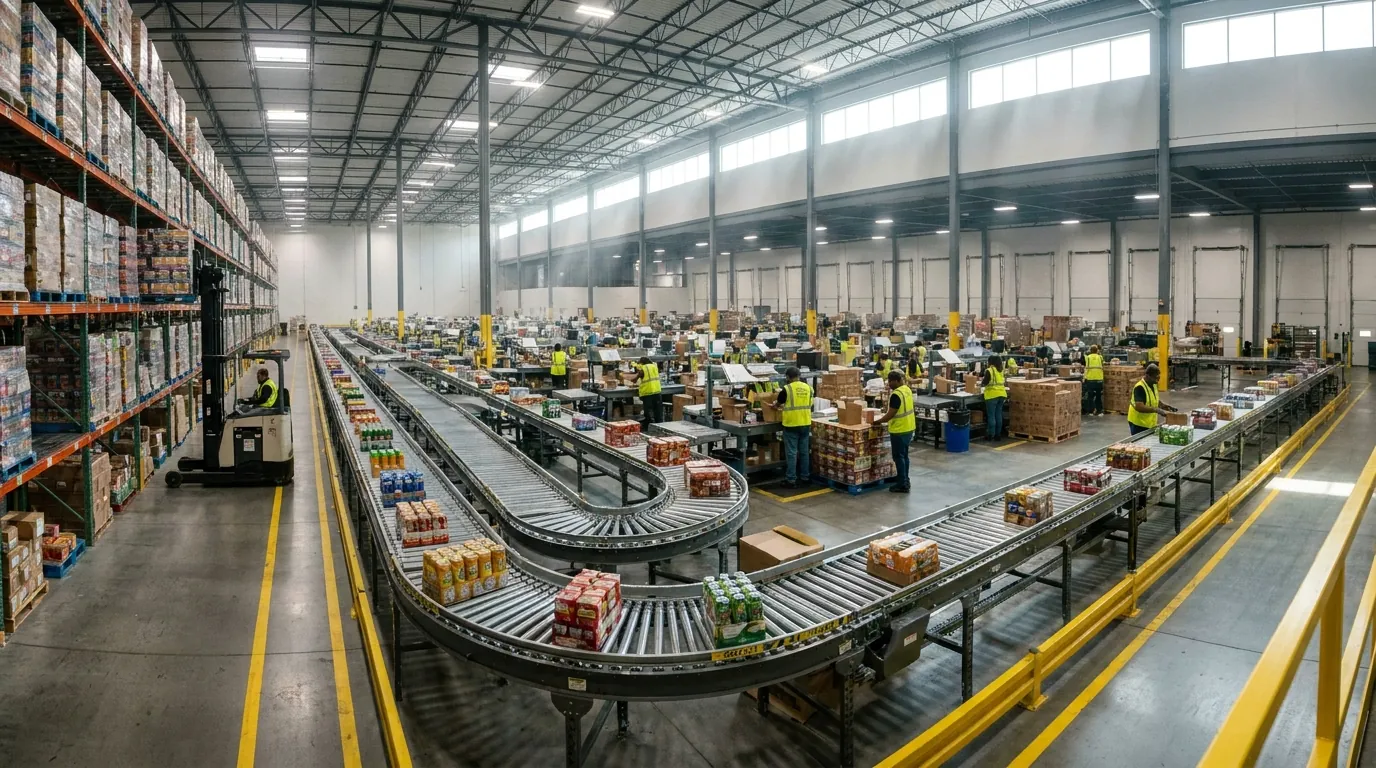
Which Picking Technologies and KPIs Actually Cut Travel Time?
Equipment moves the load, but technology decides how efficiently each picker is directed and how each pick is verified. The right tools depend on your unit-of-measure (UOM) mix. Pallet picking gains the most from scan verification and task interleaving, where a lift driver drops off a putaway on the way to the next pull instead of driving back empty. Case work gains more from hands-free direction, smarter slotting and, once volumes justify it, automation.
Whatever you deploy, measure it. Baseline a short list of KPIs before any change, then report them separately for full-pallet and case activity. A blended facility average hides where the minutes actually go.
RF Scanning, Voice, Pick-to-Light, AMRs and Goods-to-Person
- RF scanning: Handheld or truck-mounted scanners confirm the location, license plate number (LPN) and SKU before the load moves. It is the baseline for pallet picking and for most case operations.
- Voice picking: Operators hear instructions through a headset and confirm with a spoken check digit, so hands and eyes stay on the product. It suits building mixed pallets from case locations.
- Pick-to-light: Lights mounted at each slot display the quantity to pull. It performs best in dense split-case areas and fast-moving case zones.
- AMRs (autonomous mobile robots): Robots shuttle totes or pallets between pickers and zones, so people stay in a small area instead of walking long aisles.
- Goods-to-person systems: Automated storage and retrieval brings inventory to a stationary workstation. It removes most walking but demands significant capital and fits high-volume split-case operations.
For a mid-size distributor handling both pallets and cases, RF or voice paired with sound slotting and WMS-directed batching usually captures a large share of the available savings before automation makes financial sense. Our overview of warehouse picking software explains how directed picking and batching logic work in practice.
Slotting by Velocity and Cube
Slotting means assigning each SKU to a specific pick location. Velocity-based slotting puts the fastest movers, ranked by picks or cases shipped per period, in the most reachable spots: near shipping, at waist height and along the main path. Cube-based slotting sizes every location to hold enough product that replenishment trips stay infrequent.
Most teams start with an ABC analysis. A items, usually a small fraction of SKUs that generate the bulk of picks, go in a golden zone close to the dock. B items sit mid-path. C items move to the back of the building or to upper levels served by order picker machines. Re-slot on a regular schedule, since seasonal demand can quietly push today's fast movers into yesterday's slow locations and add steps to every route.
KPI Benchmarks to Track: Pallets and Cases per Hour, Accuracy, Cost per Case, Travel Ratio
Five measures cover most of what matters, and each one needs a specific reading:
- Pallets per hour: Full-pallet pulls completed per operator hour. Compare it against rack height and average trip distance, since tall reserve and long drives both pull the number down.
- Cases per hour: Carton picks completed per picker hour. Split it by technology (RF, voice, light) to see what each tool adds.
- Pick accuracy: Lines picked correctly divided by total lines. Set a target, then trace every miss back to its root cause.
- Cost per case: Picking labor dollars spread over cases shipped. Watch the trend for each method rather than chasing a single figure.
- Travel ratio: Travel time as a share of total pick time. In manual carton zones, walking is often the largest single slice.
Capture each KPI at the same interval (weekly is common) so a change in slotting or batch size shows up as a clear before-and-after shift rather than noise.
Published benchmarking, such as WERC's annual DC Measures report, offers medians and best-in-class ranges for comparison. Treat those figures as context. The benchmark that should drive decisions is your own baseline, tracked over time and separated by picking method.
How Does a WMS Direct Pallet Picking and Case Picking Together?
Running both methods in one building only pays off when something decides, line by line, which method each order line should use. That decision happens too often, and depends on too many details, for a supervisor with a clipboard. A warehouse management system makes it at release time, using rules you configure, so operators receive tasks already matched to the right equipment and location.
Unit-of-Measure Allocation: Deciding Pallet vs. Case Automatically
Every SKU carries a unit-of-measure hierarchy: eaches per case, cases per layer, layers per pallet. When an order drops, the software compares the ordered quantity against that hierarchy and splits the line. Take a hypothetical order for 130 cases of a product stored 48 cases to a pallet. The system allocates two full pallets from reserve (96 cases) and the remaining 34 cases from the forward case-pick slot. Nobody has to do the math, and no picker breaks down a whole pallet just to ship most of it.
Allocation rules can also respect constraints that matter on the floor:
- Rotation logic such as FIFO or FEFO, so a newer lot is not pulled from reserve while older stock sits in the pick face
- Near-full thresholds, for instance pulling the entire pallet and returning four cases when that costs less labor than picking 44 cartons by hand
- Replenishment triggers that fire when case picks drain a forward location below its minimum
Pick-Path Optimization and Batching
Once lines are split, tasks get sequenced by location rather than by order. Case picks across several orders can be batched into one trip and sorted by aisle and slot, so a picker walks a single serpentine route instead of doubling back. Full-pallet tasks follow different logic: reach trucks and counterbalance forklifts work best when consecutive pulls sit near each other, so the WMS groups them by zone and lift height. To see what directed routes look like on a working floor, the warehouse order picking video shows how sequenced tasks cut wasted steps.
Mixed-Pallet Building and Equipment-Aware Task Interleaving
Case picks often end up on a mixed pallet bound for one store or customer. Good software plans that build before anyone touches a carton: heavy, crush-resistant items on the bottom, lighter goods on top, and product families grouped so the receiving site can put away quickly. Pick sequence follows the build plan, which means the shortest path sometimes yields to stacking rules. The system has to weigh both.
Interleaving adds another layer. A forklift driver who drops a load at the dock can be handed a putaway or replenishment task for the return trip instead of driving back empty. Because the WMS knows which vehicle each operator is signed into, it only offers work that equipment can perform: no reserve pulls sent to someone on a walkie rider, no top-level picks assigned to a truck that cannot reach them.
Decision Framework Recap
- Order quantity at or near a full pallet: pull from reserve with a lift truck
- Quantities in cases or layers: pick from forward slots, batched by zone
- Mixed-SKU destinations: case pick to a planned build sequence
- Heavy volume of both: let the system allocate by unit of measure and interleave tasks across equipment types
The goal is not choosing one method over the other. It is letting every order line take the shortest path its quantity allows, with software making that call thousands of times a shift. Request a Demo if you would like to see Cadre Technologies' warehouse management system in action.
Frequently Asked Questions
What is pallet picking?
Pallet picking means retrieving an entire pallet of one SKU and moving it intact to staging or shipping without breaking it into cases. One move fills one order line, which gives it the lowest handling time per unit of any picking method. It fits order lines where the quantity meets or exceeds the Ti-Hi, which is cases per layer multiplied by layers per pallet.
What is the difference between pallet picking and case picking?
Pallet picking moves one SKU in one large unit, while case picking pulls individual unopened cartons of many SKUs to build a mixed pallet or cart. Full-pallet picks need little travel per unit, since one trip moves 40 to 80 or more cases. Case picks involve many stops per order, so walking or driving often becomes the biggest share of picker time.
When should I use layer picking instead of full pallets or cases?
Layer picking makes sense when order quantities regularly land on layer multiples below a full Ti-Hi and the product is uniform and stable, such as shrink-wrapped beverages or canned goods. Operators or vacuum and clamp equipment lift complete tiers onto an outbound pallet. If layer-sized orders are rare, most operations treat them as case picks and reserve layer equipment for consistent, high-volume SKUs.
Does batch picking actually reduce travel time?
Batching usually cuts travel when orders are small compared with a pallet and share aisles or SKUs. In a hypothetical wave of 40 orders totaling 1,200 cases, batching two orders per trip dropped travel roughly 39% and total labor about 17% versus discrete picking. It helps less when single orders already fill a pallet or when orders carry separate hard carrier cutoffs.
What equipment is best for picking full pallets?
Reach trucks are the usual choice for pulling full pallets from high reserve racking, since they operate in narrower aisles of about 8 to 10 feet. Counterbalance forklifts handle floor-stacked loads and dock work well but need aisles of roughly 11 to 13 feet. Near the dock, electric pallet jacks often cover less distance per pull for floor-stack loads.
How does a WMS decide whether to pick a pallet or cases?
A WMS compares each ordered quantity against the SKU's unit-of-measure hierarchy and splits the line at release time. For example, a hypothetical order for 130 cases of a product stored 48 per pallet becomes two full pallets from reserve plus 34 cases from the forward slot. Rules can also enforce FIFO or FEFO rotation and trigger replenishment when pick faces run low.